In this interview, we look back on the pilot phase of the Berlin “ Jugendkulturinitiative ” and discuss the insights gained from working with the participating organizations and young people.
How did the " Jugendkulturinitiative " come about, and what is your role in it?
The idea for the “ Jugendkulturinitiative ” (Youth and Culture Summit) originated in 2023. In January, the second summit on youth violence had taken place, convened by the then-governing mayor, Franziska Giffey. One outcome of this summit was an agreement among the administrative departments to develop preventive measures against youth violence. For the cultural sector, this raised the question of what role cultural education programs could play. One point of reference was the Interdepartmental Community Initiative, which, based on data and statistics from the Senate Department for Urban Development, Construction, and Housing, examined [1]to identify which Berlin social areas are structurally underserved.
Building on that, this idea emerged: How can we strengthen cultural education programs precisely where a structural shortage has been identified—not only across various dimensions of programming but also specifically in cultural offerings and cultural education? The next step was to develop a clear strategy, and the “ Jugendkulturinitiative ” initiative is, in a sense, the answer: Through the “ Jugendkulturinitiative ” initiative, the Senate Department for Culture and Social Cohesion has created a funding program—and thus an incentive—for cultural institutions to work and make an impact even beyond their immediate vicinity.
I joined Berlin Mondiale after it had already been decided that the program would be funded through the two-year budget. This made it possible to create a position to coordinate the initiative and, at the same time, further develop its content.
How does Berlin support institutions participating in " Jugendkulturinitiative"?
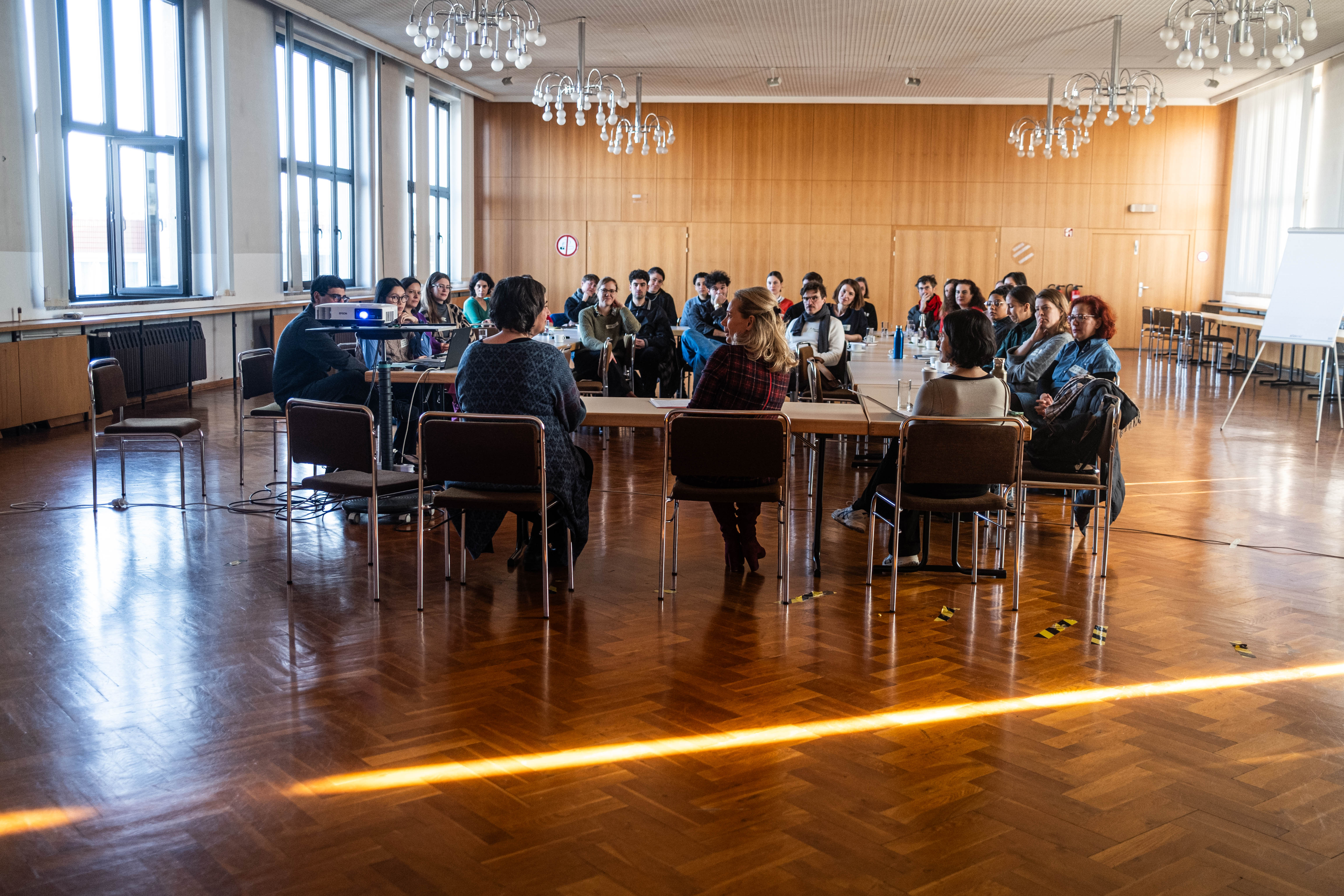
This begins as early as the application phase: We host in-depth information sessions where interested parties and eligible applicants can get answers to general questions. In the new application phase, we have introduced thematic information sessions. For example, a colleague from the neighborhood management team discusses the topic of social space orientation to foster a deeper exchange on the subject.
We also offer one-on-one consultations for staff members at the applying organizations, during which we address individual questions and issues. During the concept development phase, you can discuss specific ideas with us; if you’re still in the very early stages, we can help you get your bearings. After all, it’s not typical in this line of work to take a holistic view of social spaces and develop ideas from there. We also assist with selecting potential partners and spaces.
And once funding began, we held networking workshops during the pilot phase that focused on a variety of topics and invited external experts to lead workshops with our colleagues that were as practical as possible. The topics were determined based on a survey of the participating institutions. We strive to address challenges and areas of interest in a way that is as needs-based as possible and to organize events accordingly.
As the first final phase gets underway —the pilot phase is now coming to an end—a large number of colleagues from the various institutions have expressed a desire to address questions regarding Inreach processes: What does Inreach mean in concrete terms in our day-to-day work? As a facilitator, how can I implement Inreach in my institution as many small, integrated actions? Where are the resources and support for this already available within the institution itself, and how can I generate them? We then invited a colleague from organizational development to work with the staff to identify potential levers and tools from a systemic perspective.
Needs-based structures for needs-based service development, so to speak.
We take the different development processes of the institutions into account to a great extent. We look at the big picture, but also at the details, to see where the institutions stand, where there are overlaps, and how we can respond to these moments in the respective processes by providing specific content-related input.
Another important pillar of your work is knowledge transfer...
... specifically, both the transfer of knowledge among participants and at the cultural-policy level. For example, we organized a policy co-design workshop to convey to policymakers and administrators the working practices of our colleagues in cultural education who focus on outreach and social networking. This is to clarify exactly what this means in day-to-day work so that policymakers and administrators can establish appropriate framework conditions or take them into account for the future. With the same goal in mind, we share the experiences gained from the program at meetings, conferences, and in cultural policy discussions.
The " Jugendkulturinitiative " initiative aims to spark interest in cultural programs among future generations, particularly in neighborhoods where cultural participation has been virtually nonexistent for various reasons. What must institutions consider when developing needs-based cultural programs in previously disadvantaged communities?
When organizations seek to make an impact in a neighborhood or social context, they may be breaking new ground within their own work context. It is important to realize that these social contexts are not blank slates. There is already a wealth of relationships, knowledge, experiences, and effective forms of collaboration in place locally—even in areas that, from an urban development policy perspective, are considered structurally underserved.
Given this on-the-ground situation, the stakeholders have found viable solutions through collaboration and bring a wealth of expertise to the table. By raising awareness of this, the institutions can then consider where within this existing system they can make a meaningful contribution. Positive effects can be amplified, and perhaps new initiatives can be launched in collaboration with local colleagues—initiatives that previously could not be implemented due to a lack of financial or other structural resources.
I’d say the biggest step is a shift in mindset. Often, the logic goes like this: We go somewhere, look for a one-time collaboration, and carry out a project over a period of X. And then the relationship often works like this: We bring a proposal, you bring us the people who will participate, and that’s the extent of the collaboration. But if I imagine myself entering an existing system, I have to make different decisions or plan differently.
And since this is specifically about working with young people: What specific considerations should be kept in mind during this outreach process?
Jugendkulturinitiative ’s focus is on processes—that is, on long-term work with young people, children, and adolescents—and aims to foster sustainable social integration within the local community. It is important to note that these programs are intended to take place outside of school hours or, for example, outside of daycare hours. This means that the organizations must make a much greater effort to understand the everyday realities of their selected target groups. For example, participants cannot be recruited through existing school classes.
To put it simply, the collaboration model has often worked this way so far: Participants are already gathered in some form—in a school class, for example, or in a daycare group—and are taking part in an existing program at a facility. Now, however, the challenge is to step outside one’s own facility and bring together a new group of young people. That’s why, as a staff member at a cultural institution, you have to experiment with ways to inspire trust and then build on it. To do this, it’s essential to understand who the young people in that particular social context are. Unfortunately, this is often underestimated: the research and getting-to-know-them process required for this take a great deal of time and also require a different approach.
That’s why it’s good that “ Jugendkulturinitiative ” promotes precisely this process and is less output-oriented. Colleagues from the participating organizations have reported that it can take at least half a year to get a initial sense of the social context and to build rapport with the participants. And even then, that’s no guarantee that the participants will actually show up regularly.
What insights have you gained from the pilot phase of the " Jugendkulturinitiative " regarding the funding structure?
For further reading: The Institute for Research on Cultural Participation (IKTf) has also summarized key success factors for engaging young people in an accompanying publication.
The most important insight is that, from a funding policy perspective, it makes sense to support processes rather than individual projects when the goal is to bring about genuine change within institutions. After all, the “ Jugendkulturinitiative ” initiative aims not only to expand program offerings but also to open up institutions—toward greater permeability, decentralized formats, and other forms of collaboration. Such changes cannot be achieved through short-term, one-off projects.
Process facilitation creates the space for a gradual shift in thinking, for “aha” moments, and for the development of new approaches. In this context, innovation does not arise on the drawing board, but rather through concrete work on the ground—through encounters, through dialogue, and through the gradual building of trust.
And how did you manage to cope with the suspension of funding?
This is the second key insight: Interruptions in such processes always entail a significant amount of extra work —regardless of how long they last. The cancellation of funding for 2025 resulted in the loss of about half a year before funding could be resumed. The consequences, however, extended far beyond that period.
In outreach work in particular, trust with participants and partners was painstakingly built up over months. Then, for six months, it was no longer possible to guarantee any services or continuity, which meant the participants left—for good. They did not return even when the program restarted after half a year. The trust that had been built up was not enough to bring them back.
This also led to the breakdown of partnerships. The interruption in funding meant that many partners were themselves in a precarious financial situation. Where an institution had previously been able to contribute resources through the “ Jugendkulturinitiative ” initiative, those resources were no longer available, meaning that some partner institutions were no longer able to participate at all. Building up this momentum only to then have to deal with a politically driven interruption in funding had a profoundly demoralizing effect on our colleagues. They, too, had to recover first.
What have you learned about change processes?
A “transformation” often sounds more significant than it initially appears to be in practice. More often than not, it’s actually about moments of transformation —that is, smaller but lasting shifts in work practices, perspectives, or institutional routines.
In the policy co-design workshop, as well as in the one-on-one discussions during the support process, we were able to identify most clearly where real progress had been made or experiences gained that we believe could bring about lasting changes in the work practices of our colleagues or the organization.
Furthermore, it has become clear that projects that succeeded in establishing sustainable socio-spatial partnerships were able to respond to crises with significantly greater resilience. This became apparent even during the funding hiatus—that is, after just under a year. In cases where strong relationships and effective collaboration had already been established, ways were more likely to be found—even during the funding hiatus—to continue processes in some form—for example, through alternative grant applications, additional support from partners, or the organizations’ own funds.
In projects that were not yet as far along, these structures fell apart much more quickly. This, too, underscores how crucial ongoing relationship-building is to the stability of such processes.
And how do you look back on your own activities?
First, there’s our supporting program: The peer-to-peer approach—where colleagues themselves serve as knowledge carriers and multipliers—has proven to be very productive. We put a lot of thought into how to structure the program in terms of content and organization, and over time we realized: The more successfully we were able to create a framework in which experiences could be shared, reflected upon, and documented, the greater the added value. The priority was then less about having the invited experts speak, but rather that these experts were just one of many experts from the institutions—only with an outside perspective—who then engaged in a conversation, a discussion, or a debate. Equally central was the continuous process support. Close contact with colleagues created a solid working foundation that enabled open and constructive exchange. This played a key role in ensuring that the willingness to participate—despite all the uncertainties of the pilot phase—remained consistently high.
What is your outlook regarding the initiative's future funding?
The pilot phase ends in late June, and the application period for the second round of funding began in March and has now concluded. The funding allocation has been doubled, meaning that twenty institutions—rather than ten—can now receive funding. In the second round of funding, a willingness to collaborate with Berlin Mondiale is listed as a mandatory criterion, so we look forward to a very active and dynamic partnership with the institutions that will receive funding in the future.
At the same time, the political situation is not without uncertainty: It’s an election year, and budget negotiations are also on the horizon. However, we feel that we’ve already been able to convey to many decision-makers the impact the initiative has had and the potential it holds. If the funding approvals come through as planned, Berlin Mondiale will also expand its staff.
What might the future development of your activities look like?
In terms of content, we want to make the support program more modular and, at the same time, more resilient. During the pilot phase, the interaction with the ten participating organizations was still very close-knit and almost intimate. With twenty organizations, we now need a more systematic approach to ensure that the support remains impact-oriented while also being better able to respond to potential disruptions. To this end, we can learn from the feedback provided by the organizations that have received funding so far and build on the experiences of the pilot phase. We are considering what kinds of exemplary initiatives we could incorporate into the structure of the support program. One major issue, for example, is the protection of children and youth. This raises the question of how a support structure can not only offer training but also foster synergies between the participating institutions and their social partners.
And what are some considerations regarding knowledge transfer?
The question of how to make the knowledge generated through the program visible and usable will continue to be a focus for us. Originally, we had conceived of the workshops as training opportunities; looking ahead, we could strengthen the peer-to-peer effect by creating internal spaces for knowledge production and exchange. Other formats, in turn, could be made available to a (specialized) audience. We will continue to develop this further.
How can young people get involved in these processes?
A key focus of the second funding round is to incorporate young people’s perspectives more fully. This was part of the plan from the outset, but could not be fully implemented during the pilot phase. In this new round, young people are participating on the jury, and we also plan to develop a few program formats together with them. For us, this is also an opportunity to maintain and deepen the connections we’ve already established with young people.
_____________________
The interview was recorded in April 2026, and the transcript was edited by Jo Schindler.
Jo Schindler works as a postdoctoral research assistant in the Department of Expanded Museum Studies at the University of Applied Arts Vienna, and as an editor and translator (Finding Words). With a background in cultural studies and cultural management, specializing in sociology, Jo writes and teaches on issues related to the production of knowledge and discourse. Previously, Jo worked at the House of World Cultures in Berlin and for the Journal of Cultural Management and Cultural Policy, among other roles.